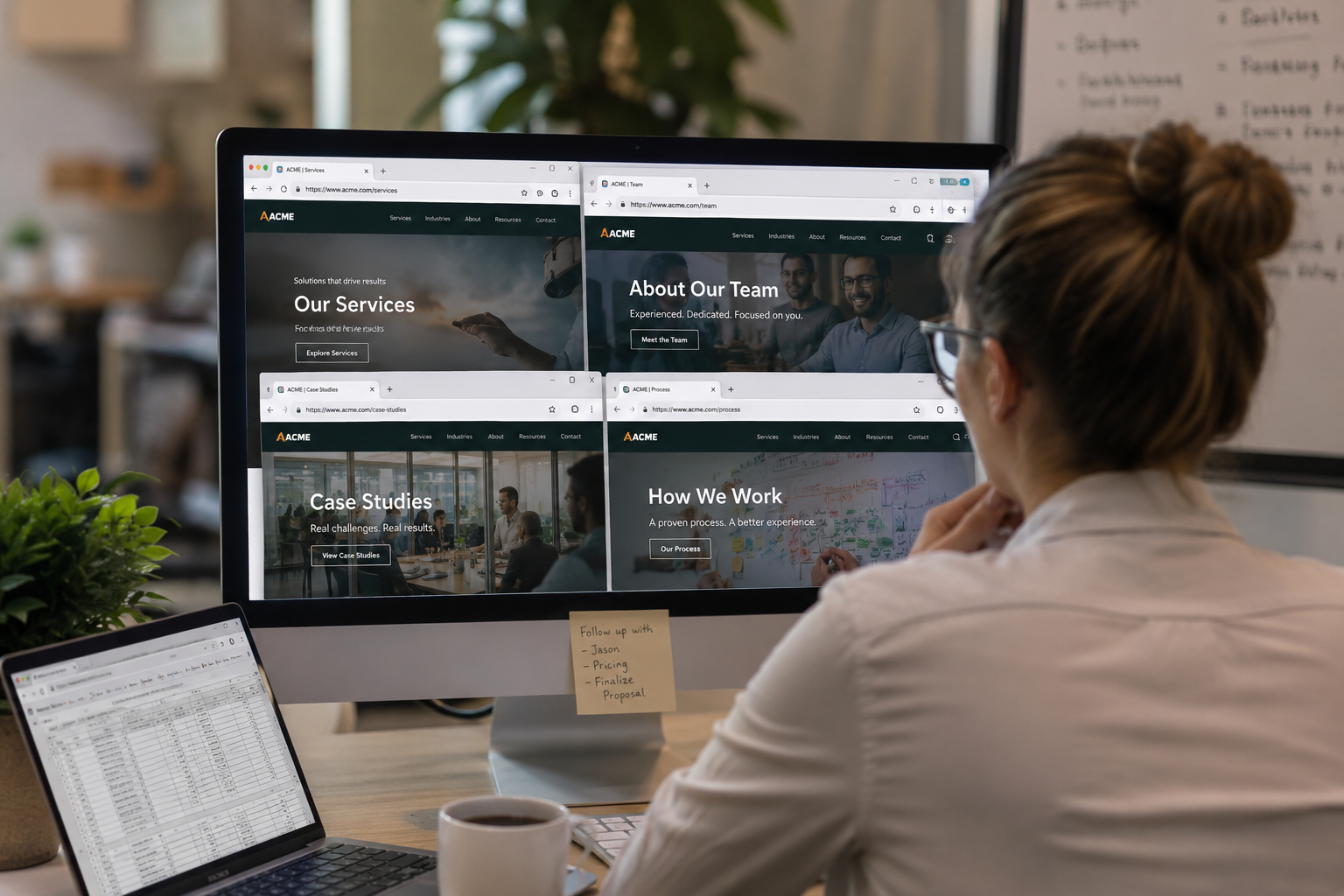
B2B websites have traditionally been built around the assumption that buyers would land on the homepage, explore a few top-level pages, and then contact sales for more information.
But that’s no longer how most buyer journeys work.
Now, B2B buyers conduct extensive independent research before they even speak to a salesperson.
Recent buyer research illustrates the scale of this change. SurveyMonkey reports that 83% of decision-makers conduct independent research before speaking with sales, while 51% of B2B software buyers begin their research with AI tools.
They have evaluated options, compared providers, reviewed evidence, and validated potential partners all on their own.
As you can imagine, this shift has fundamentally changed the B2B buyer’s journey.
For example, while many organizations continue to invest heavily in homepage messaging, buyers often skip the homepage altogether. They now typically navigate directly to the more specific, targeted pages that help them evaluate risk, validate expertise, and build confidence in a potential purchase decision.
At Three29 we want you to understand which pages buyers actually care about and how they are absolutely essential for creating a website that supports conversion and independent evaluation.
Table of Contents
Why Buyers Often Skip the Homepage
It’s true that the homepage definitely remains important, but its role has changed dramatically.
Instead of the homepage, it’s search engines, referral links, AI-generated answers, industry directories, and shared content that frequently direct visitors to your more targeted pages.
Buyers often arrive with a specific question already in mind, so instead of starting with broad brand messaging, you should provide immediate answers to their questions such as:
- Can this company solve my problem?
- Do they have experience in my industry?
- What results have they achieved?
- Who will I be working with?
- How much might this cost?
- What makes them different from alternatives?
The vast majority of buyers skip generic homepages because they focus on broad value propositions that sound boringly similar across competitors.
And while homepages are certainly useful for brand positioning, they often lack the specificity buyers need to move forward confidently with a decision.
Pages filled with generic claims, buzzwords, and vague promises also rarely help buyers validate a purchasing decision. The buyers you’ll interact with today are looking for proof, context, and details rather than simply slogans.
Key Page Types for B2B Buyers
As buyers progress through the evaluation phase of the B2B buyer journey, these are the page types that consistently influence trust and confidence.
The ones that potential customers bookmark and forward to the stakeholders and decision-makers in their company as needed.
1. Service Pages
Strong service pages are often some of the most important assets on a B2B website.
Buyers use these pages to understand:
- What services are offered
- How solutions are delivered
- Who the services are designed for
- Expected outcomes
- Differentiators from competitors
The most effective service pages go way beyond basic descriptions to explain real business problems, provide examples, and demonstrate expertise in a specific area. When service pages are thin, vague, or overly promotional, buyers are actually left with more unanswered questions that create friction in the evaluation process.
2. Case Studies
It’s reasonable that buyers want evidence before making a decision, and well-structured case studies help validate claims by showing how a company has previously solved similar challenges for real clients.
Prospective customers often review case studies to assess things like:
- Industry experience
- Problem-solving capabilities
- Measurable outcomes
- Project complexity
- Long-term success
These case studies reduce uncertainty because they transform marketing promises into documented results. In fact, for many buyers, case studies serve as one of the strongest decision-validation tools on a website.
3. About Us and Team Pages
It’s also important to remember that the people behind a company matter more than many organizations realize. Buyers frequently visit team pages to understand:
- Leadership experience
- Industry expertise
- Company culture
- Team size and capabilities
- Who they may work with directly
Especially in service-based industries, buyers often evaluate both the company and the people delivering the work. A thoughtful team page can therefore create trust and humanize the organization in ways that product messaging alone cannot.
4. FAQ Pages
Throughout the evaluation process, buyers naturally develop questions, so a comprehensive FAQ section helps address common concerns before they become obstacles.
Common topics include:
- Project timelines
- Process expectations
- Pricing considerations
- Technology platforms
- Communication methods
- Support models
Effective FAQs can help to reduce friction while supporting a stronger conversion strategy by removing uncertainty before a sales conversation occurs.
5. Comparison Content
Savvy buyers also compare vendors independently, searching for things such as:.
- Solution comparisons
- Vendor alternatives
- Platform differences
- Service model distinctions
Organizations and companies that can create transparent comparison content can help buyers make informed decisions while controlling the narrative around competitive differentiation at the same time.
On the other hand, when comparison content is absent, buyers often seek answers elsewhere which can cost you a client.
6. Plans and Pricing Pages
Pricing is incredibly important even though many companies hesitate to discuss it online. Buyers want transparency, however, and consistently seek cost-related information during research.
This doesn’t necessarily mean publishing exact rates. Buyers can also benefit from:
- Budget expectations
- Pricing factors
- Scope considerations
- Cost drivers
- Investment ranges
Pricing guidance helps buyers determine whether a solution aligns with their budget before engaging sales, and without it, uncertainty increases and trust often declines.
What B2B Buyers Look For During Evaluation
When you’re looking at the data across all high-performing pages, you’ll notice that buyers tend to evaluate similar signals such as:
Clarity
Buyers want straightforward answers. Complex language, jargon, and vague positioning often make evaluation more difficult. Clear messaging allows visitors to quickly understand:
- What the company does
- Who it serves
- How it creates value
- Why it is different
Specificity
Specific information builds confidence, and buyers trust details more than generalizations. For example:
- Specific outcomes outperform generic promises.
- Detailed processes outperform abstract descriptions.
- Real examples outperform hypothetical scenarios.
Making sure your site is specific enough helps buyers validate their assumptions and move forward with even greater confidence.
Credibility
Buyers actively search for signals that reduce risk, and the stronger these validation signals are, the easier it becomes for buyers to justify contacting sales. Some validation signal examples include:
- Case studies
- Client testimonials
- Certifications
- Industry expertise
- Team experience
- Documented results
How AI Is Changing B2B Website Navigation
AI is quickly reshaping how buyers discover and consume information.
This preference for independent research is measurable: Gartner found that 61% of B2B buyers prefer an overall buying experience without a sales representative.
Instead of browsing websites sequentially, many buyers now use AI-powered search tools to find direct answers. As a result of this:
- Internal pages receive more direct traffic.
- Buyers land deeper within websites.
- Individual pages must stand on their own.
- Content structure becomes increasingly important.
This AI shift also means companies can no longer rely on a homepage-first experience. Rather, each and every page should function as a potential entry point into the buyer journey.
Companies that can align content architecture with both search behavior and emerging AI discovery patterns are better positioned to support modern evaluation processes.
Common Mistakes
If buyers cannot find answers quickly, they may leave and continue their research elsewhere. Unfortunately, as it stands, many B2B websites unintentionally slow down buyers by creating unnecessary barriers with issues such as:
- Overinvesting in the Homepage – A polished homepage cannot compensate for weak supporting content; buyers eventually need detailed information to validate their decisions.
- Thin Service Pages – Short, generic service descriptions leave important questions unanswered.
- Hidden Proof Points – Case studies, testimonials, and examples should be easy to find and navigate.
- Difficult Navigation – Poor website UX can make valuable content difficult to locate.
- Inconsistent Messaging – Conflicting messages across pages can reduce confidence and create confusion during evaluation.
How to Build B2B Websites Around Real Buyer Behavior
Ideally, B2B websites should be designed around how buyers actually research, evaluate, and validate decisions. The goal is no longer simply generating leads, but supporting independent evaluation.
This means creating a website experience where buyers can easily access the information they need, understand it quickly, and build confidence in their decision before speaking with sales.
At Three29, we design websites around real buyer behavior rather than outdated navigation assumptions. Our approach prioritizes clarity, usability, and conversion support across every stage of the evaluation process.
By aligning website UX, messaging, content architecture, conversion strategy, and emerging GEO (Generative Engine Optimization) principles, we help companies create scalable digital experiences that support modern buying journeys and drive stronger business outcomes.
At Three29 we know that as the B2B buyer journey continues to evolve, the companies that win will be the ones whose websites make evaluation easier, not harder, and we’re here to help you do just that.